September 24, 2026
6 min
An AI receptionist checks real-time schedules, matches providers and rooms, and confirms before updating, helping dental practices reschedule appointments without double-booking.
April 24, 2026
8 min
Understand dental CRM vs lead management, their roles in patient acquisition and retention, and how choosing the right system can boost conversions and revenue.

A practice we spoke with last quarter was running four thousand dollars a month in Google Ads and could not explain why new patient numbers had flattened. The ads were fine. The keywords were fine. What they had was a system that stored patient records beautifully and a front desk drowning in unanswered forms, unreturned voicemails, and inquiries nobody had assigned to anyone. They had a CRM. What they were missing was a dental lead management system, and the gap between those two things was quietly costing them tens of thousands of dollars a year.
Many dental practices assume a CRM and a lead management system are essentially the same tool wearing two names. Both deal with patient data. Both track interactions. Both show up in the same buyer's guides. So when one is already in place, adding the other can feel redundant, another subscription, another login, another thing to train the team on.
That assumption is exactly why so many practices lose high intent inquiries, delay follow ups, and struggle to convert leads into booked appointments. A CRM and a lead management system look similar on the surface, but they protect two completely different moments in the patient journey, and confusing them is one of the most expensive mistakes a growing practice can make.
This guide breaks down the real difference between dental CRM vs lead management based on how practices actually operate, not how software vendors describe their own products. You will see what each system is built to handle, where it sits in the patient journey, and when using one, the other, or both together makes the most sense for your growth.
Before defining either tool, it helps to step back and look at the problem both are trying to solve, because once that is clear, the choice becomes far easier.
Most dental practices are not struggling to generate interest. They are already investing in Google Ads, local SEO, social media, and referrals. The flow of inquiries is there. Calls are coming in. Forms are being filled out. Messages are landing in an inbox somewhere.
The problem is that a large share of that opportunity never turns into a booked appointment. Around 32 percent of calls to dental practices go unanswered during business hours. That is nearly a third of potential patients who never get a response at all. Of the calls that are answered, only about 42 percent convert into appointments. If your marketing generates 100 inbound calls this month, roughly 70 of those potential new patients never make it into your chair.
Now consider what that actually costs. A single missed new patient can represent around 2,000 dollars in lifetime value at the low end, and anywhere from 8,000 to 22,000 dollars once you factor in long term treatment, repeat visits, and referrals. Miss just ten or twelve of these opportunities in a month, and the lost revenue adds up fast, often without the practice ever realizing it happened.
This is where most practices misdiagnose the issue. It feels like a marketing problem, but it usually is not. The demand already exists. The real gap sits in how that demand gets captured, tracked, and followed up on. Many practices only see this clearly once they start looking for ways to stop inquiries from slipping through the cracks and see, in hard numbers, how much revenue had been leaking out unnoticed.
That gap is exactly where the difference between a dental CRM and lead management for dentists starts to matter. Both tools are built to address this problem, but each one solves a different half of it.
The confusion does not come from complexity. It comes from surface level similarity. Both systems display contacts, conversations, and activity timelines, which makes them look interchangeable at a glance. That assumption is exactly where most practices lose clarity, and eventually revenue.
A dental CRM is built to manage relationships over time. It organizes communication, tracks patient interactions, and supports long term engagement. It becomes most valuable after someone has already entered your ecosystem, helping your team stay consistent, responsive, and organized across every future touchpoint.
Lead management operates at a completely different moment in the journey. It focuses on the first interaction: capturing every inquiry, assigning it instantly, and making sure follow up happens fast. Its purpose is speed, accountability, and conversion. Practices that understand this distinction often look into how a dedicated patient relationship platform complements the systems they already have.
Both systems touch patient data, but they serve different stages of intent. One nurtures relationships that already exist. The other captures and converts opportunity before it disappears. Understanding that distinction is what lets you choose the right system based on where your practice is actually losing patients, not based on a features list.
CRM stands for Customer Relationship Management. In dentistry, patient relationship management is probably the more accurate term, but the software industry is stuck with CRM, and it is what most people search for anyway.
A dental CRM is a tool built to manage and nurture ongoing relationships with both existing patients and prospective ones. It remembers who your patients are, what treatments they have had, how long it has been since their last visit, what their insurance situation looks like, and how they prefer to be contacted.
Think of a CRM as your practice's long term memory. It builds rich patient profiles over time, helping your team deliver a more personal experience at every touchpoint. The best dental CRMs also layer in automation, things like appointment reminders, recall campaigns, birthday messages, and post treatment follow ups, so your team is not relying on memory to catch all of it. Many practices adopt these tools after understanding why structured patient communication matters for growth.
What a dental CRM typically does well:
In short, a dental CRM is built to keep the patients you already have and deepen those relationships over the long run.
Dental lead management software serves a fundamentally different purpose. Where a CRM focuses on existing patients and ongoing relationships, lead management software focuses almost entirely on the critical window between when someone first inquires about your practice and when they either become a patient or disappear for good.
This is the phase most dental practices handle worst.
When a prospective patient fills out a contact form at nine at night on a Thursday, a dental lead management system captures that inquiry immediately, categorizes it, triggers an automatic acknowledgment so the person knows they have been heard, and queues the lead for your front desk to act on first thing Friday morning. The same thing happens if they called and left a voicemail instead.
Without a system like this, that inquiry lands in someone's inbox, gets buried under forty other unread messages, and the patient who was probably researching three or four practices at once books with whoever responded first. Many growing practices solve this with a centralized inquiry tracking system that makes sure no opportunity slips through.
That is not a hypothetical. Data consistently shows that practices responding within five minutes are roughly ten times more likely to convert an inquiry into a booked appointment than practices that respond after thirty minutes, and separate industry benchmarking puts the advantage at more than double the conversion rate for five minute response versus a manual callback process. Meanwhile, practices without automated follow up lose an estimated 30 to 50 percent of inbound leads from paid ads within the first hour alone. The average dental practice response time still sits somewhere around 47 hours.
What dental lead management software typically does:
Where a CRM manages the ongoing patient relationship, lead management software manages the moment of acquisition, from first inquiry through first appointment.
Here is the simplest way to think about it. A CRM answers: how are we managing the patients we already have? Lead management answers: what is happening to the people trying to become our patients?
One looks after your existing patients. The other makes sure new patients do not get missed.
Most dental practices already have a CRM or practice management system handling appointments, records, and ongoing communication. That part usually works fine. The gap happens earlier. Your marketing brings in calls, form fills, and messages, but without a dedicated system, many of those inquiries are not followed up properly. Some get delayed. Some get missed entirely. Some never turn into appointments. Practices that address this gap tend to focus on strategies that turn more inquiries into confirmed bookings rather than simply increasing marketing spend and hoping the front desk keeps up.
That is where most revenue quietly disappears. Lead management fills this gap by making sure every inquiry is captured, tracked, and followed up on so more of those potential patients actually book.
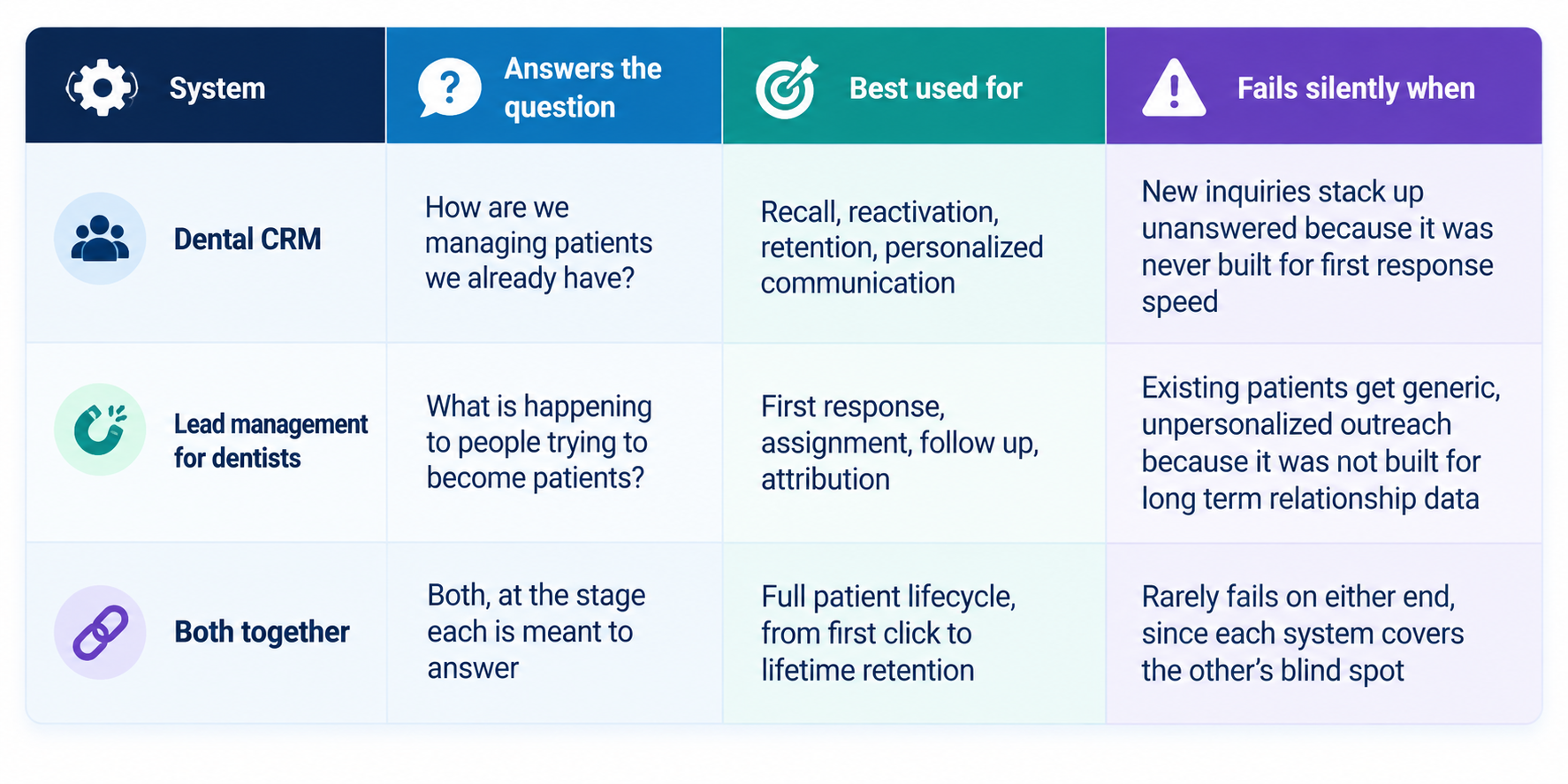
Here is where it gets practical. Based on where your biggest challenge actually is, one of these two categories usually fits.
You need a dental lead management system if:
You are spending money on marketing but cannot tell what is working. If you are running Google Ads, doing local SEO, or paying an agency every month with no clear data showing which channel generated which new patients, that is a lead attribution problem. Lead management software solves this by tracking every inquiry back to its source. Many multi location practices run into this and look into scaling patient acquisition across multiple clinics to get better visibility.
Your front desk is overwhelmed. The average front desk employee spends 50 to 60 percent of their working hours on the phone, juggling check ins, insurance questions, scheduling, and incoming calls all at once. In that chaos, new patient inquiries get missed, delayed, or followed up on too casually. Lead management software gives your team a structured, prioritized list of leads that need action, so nothing falls through without anyone noticing.
You are losing leads to competitors. If patients who inquired but did not book keep ending up at the practice down the street, slow follow up is almost certainly the reason. Automated sequences that fire within minutes of an inquiry prevent this from happening as often.
You are scaling or running multiple locations. For group practices and DSOs, the lead problem multiplies with every location added. Without centralized lead management, there is no way to compare acquisition performance across sites, identify which locations are converting well, or figure out where marketing dollars are actually generating a return.
You are investing in high value treatments. In big case dentistry, implants, full arches, cosmetic cases, the revenue impact of a lost lead is enormous. A single dropped implant inquiry can represent 6,000 to 50,000 dollars in missed production revenue. Dentist lead management ensures every high intent inquiry gets the response and follow up it deserves, every time, without depending on someone remembering to check a shared inbox.
You need a dental CRM if:
Your recall rate is suffering. If existing patients are not returning for regular hygiene appointments and you are not running systematic recall campaigns, a CRM with automated recall functionality should be a priority.
You want to reactivate dormant patients. Most practices have hundreds, sometimes thousands, of patients on file who have not been in for eighteen months or longer. A CRM lets you run targeted reactivation campaigns to bring those patients back, often at a fraction of the cost of acquiring a brand new patient.
Patient experience and personalization matter to your growth strategy. Patients who feel remembered, whose treatment history is noted and whose preferences are on file, stay longer and refer more. A CRM enables that level of personalization at scale, well beyond what a spreadsheet or sticky note system can manage.
You are building a long term retention strategy. If new patient acquisition is solid but retention is the weak point, a CRM is the right investment. It is the infrastructure for keeping patients engaged, informed, and loyal over years, not just months.
Yes, and for most practices serious about growth, the honest answer is eventually yes to both.
The patient journey has two distinct phases, and each one needs a different kind of system.
Phase one is acquisition. This covers the moment someone discovers your practice, makes an inquiry, receives follow up, and books a first appointment. This is where lead management software plays the most important role.
Phase two is retention and relationship. This begins once the patient walks through the door. It covers treatment, recall visits, referrals, and long term engagement. This is where a CRM does its best work.
The biggest gap for most practices is not in the second phase. It is in the first. This is where inquiries get missed, follow ups get delayed, and potential patients never convert in the first place. That is why starting with lead management usually delivers faster, more measurable results. Once you have clear visibility into where your patients are coming from, how quickly you are responding, and how many inquiries are converting into appointments, the foundation is in place. Many practices get there by connecting their systems and aligning marketing with operational workflows to create one continuous patient journey instead of two disconnected ones.
From there, layering in a CRM to manage the long term relationship becomes the natural next step, not a redundant one.
Whichever direction you lean, a few practical checks save you from buying the wrong tool twice.
Confirm the system integrates with your practice management software. A dental lead management system that cannot pass booked appointments back into your PMS creates a second manual data entry step, which defeats the entire point of automating follow up in the first place.
Ask how attribution reporting actually works. Some tools claim attribution but only track the last click before a form submission, missing the phone calls, texts, and multiple touchpoints that make up a real dental patient journey. Ask for a specific example of how a phone lead gets attributed to a campaign.
Check response time defaults, not just capability. A platform that can send an instant text reply is only useful if that behavior is switched on by default and easy for your front desk to monitor, not buried three settings menus deep.
Confirm HIPAA compliant communication is built in, not bolted on. Automated texting and email sequences that touch patient information need to be compliant by design, particularly once a lead becomes a patient and clinical details start entering the conversation. Our overview of CRM data hygiene covers why clean, well governed data matters just as much for a lead management system as it does for a CRM.
Is a dental lead management system the same as a CRM?
No. A dental lead management system is built for the acquisition phase, capturing and following up on new inquiries before they become patients. A CRM is built for the relationship phase, managing communication and recall with patients who are already established. They overlap in that both store contact data, but they are designed to solve different problems.
Do small, single location practices need lead management for dentists, or is that only for large groups?
Single location practices benefit just as much, sometimes more, because a missed lead has a bigger relative impact on a smaller patient base. The tools that matter most for a solo practice are instant lead capture and automated first response, not the multi location reporting features that matter more to a DSO.
What happens if a practice only has a CRM and skips lead management entirely?
New inquiries typically get handled manually, through a shared inbox or a front desk employee's memory, which is exactly the process that lets 32 percent of calls go unanswered and pushes average response time out to 47 hours. The CRM works well for existing patients but does nothing to catch leads before they walk away.
How fast should dentist lead management actually respond to a new inquiry?
Within five minutes wherever possible. Response time is one of the strongest predictors of conversion in dental marketing, and the gap between a five minute response and a thirty minute or same day response is large enough to change monthly new patient numbers on its own.



September 24, 2026
6 min
An AI receptionist checks real-time schedules, matches providers and rooms, and confirms before updating, helping dental practices reschedule appointments without double-booking.

September 23, 2026
6 min
AI receptionists can explain insurance verification, collect plan details, clarify billing terms, and answer payment questions, then pass complex account issues to your billing team.

September 21, 2026
9 min
Improve dental patient experiences with engagement technology that streamlines scheduling, strengthens retention, and eases front-desk workload.
Sign Up Now & Someone from Our Team Will Be in Touch Shortly!
Use the form below to send us a message, and we’ll get back to you as soon as we can.
.webp)
Track every marketing dollar and optimize patient conversions with ConvertLens. Gain valuable insights from your campaigns, ensuring you never miss a potential patient. Maximize ROI and grow your practice effortlessly.
-p-500.webp)