September 24, 2026
6 min
An AI receptionist checks real-time schedules, matches providers and rooms, and confirms before updating, helping dental practices reschedule appointments without double-booking.
April 18, 2026
4 min
Real time analytics helps dental practices track leads instantly, reduce missed opportunities, improve marketing ROI, and make faster, smarter decisions for growth.

Most dental practices don't have a marketing problem, they have a timing problem. We've sat across the table from clinics running solid campaigns, pulling in decent traffic, and still watching patient flow swing unpredictably month to month. The pattern is almost always the same: real time analytics wasn't part of the picture, so by the time a monthly report flagged the issue, the leads it described had already gone cold. That gap between what happened and when you found out about it is exactly what real time analytics for dental practices closes.
Real time analytics is the practice of collecting, analyzing, and acting on data the moment it's generated, not days or weeks later. Instead of waiting for a report to tell you what happened last month, real time data analytics shows you what's happening in your practice right now: which calls are ringing through, which are going unanswered, which ads are converting, and where patients are dropping out of your booking flow.
The difference is simple to picture. Traditional reporting is a rearview mirror, useful for understanding where you've been, but useless for avoiding what's directly ahead. Real time analytics is more like driving with a live map, you see the obstacle while there's still time to steer around it.
Missed calls, delayed follow ups, and broken booking flows quietly drain new patient volume, and the frustrating part is that most practices never see it happening. A widely cited industry figure puts it plainly: roughly 73% of dental appointments start with a phone call, which means a front desk that's slow to answer or a call that goes unanswered isn't a minor inconvenience, it's a lead walking straight to a competitor. Real time platforms flag missed calls the moment they happen, surface leads that haven't been followed up, and show exactly where in the funnel people are dropping off. Instead of discovering the leak next month, you close it today, and our guide on call to appointment conversion tracking walks through how to connect that tracking directly to your ad spend.
Practices that work from live data make sharper calls than the ones waiting on a monthly PDF, and the gap compounds. In a dental practice, that looks like pausing an underperforming Google Ads campaign the same afternoon it starts bleeding budget, shifting spend toward whatever's converting today, or adjusting an offer because you can see demand shifting in real time rather than guessing at it after the fact. Practices that consolidate this into a single view typically lean on marketing analytics dashboards rather than checking five separate platforms every morning. Speed here isn't a nice to have, it's the whole competitive advantage.
Spending across Google Ads, SEO, and social without real time data analytics means operating half blind: you know money is going out, but not which channel is actually bringing patients through the door versus which one is quietly wasting budget. One analysis of dental marketing spend found the average cost per acquisition climbed to $267 in 2024, up from $217 just two years earlier, and practices that track ROI properly report meaningfully higher profitability than those that don't. Real time tracking lets you attribute every call and booking back to its source, watch ROI per campaign instead of per quarter, and reallocate spend daily instead of waiting for the next billing cycle to close. For a deeper look at connecting spend to booked chairs, our piece on dental campaign ROI measurement breaks down the attribution mechanics in more depth.
Patients expect a fast response, an easy booking path, and communication that doesn't require three follow up calls to get an answer. Real time data surfaces exactly where that experience is breaking down, whether it's a lead sitting unanswered for six hours or a front desk struggling with call volume during a specific window of the day. A better experience compounds into better retention and more referrals, and referral driven patients are worth noticing: some analyses put their lifetime value well over double what paid search delivers. Practices layering in healthcare focused analytics approaches tend to catch these friction points faster than teams relying on generic web analytics alone.
Without shared data, teams operate on assumptions, and assumptions tend to protect egos more than they protect performance. Real time analytics puts front desk performance, appointment conversion rates, and training gaps in front of everyone at once, which builds accountability without anyone needing to hover over a shoulder. It's a quieter benefit than the ROI numbers, but it's often the one that changes team behavior fastest.
It helps to see the two approaches side by side, because the gap is bigger than it looks on paper.
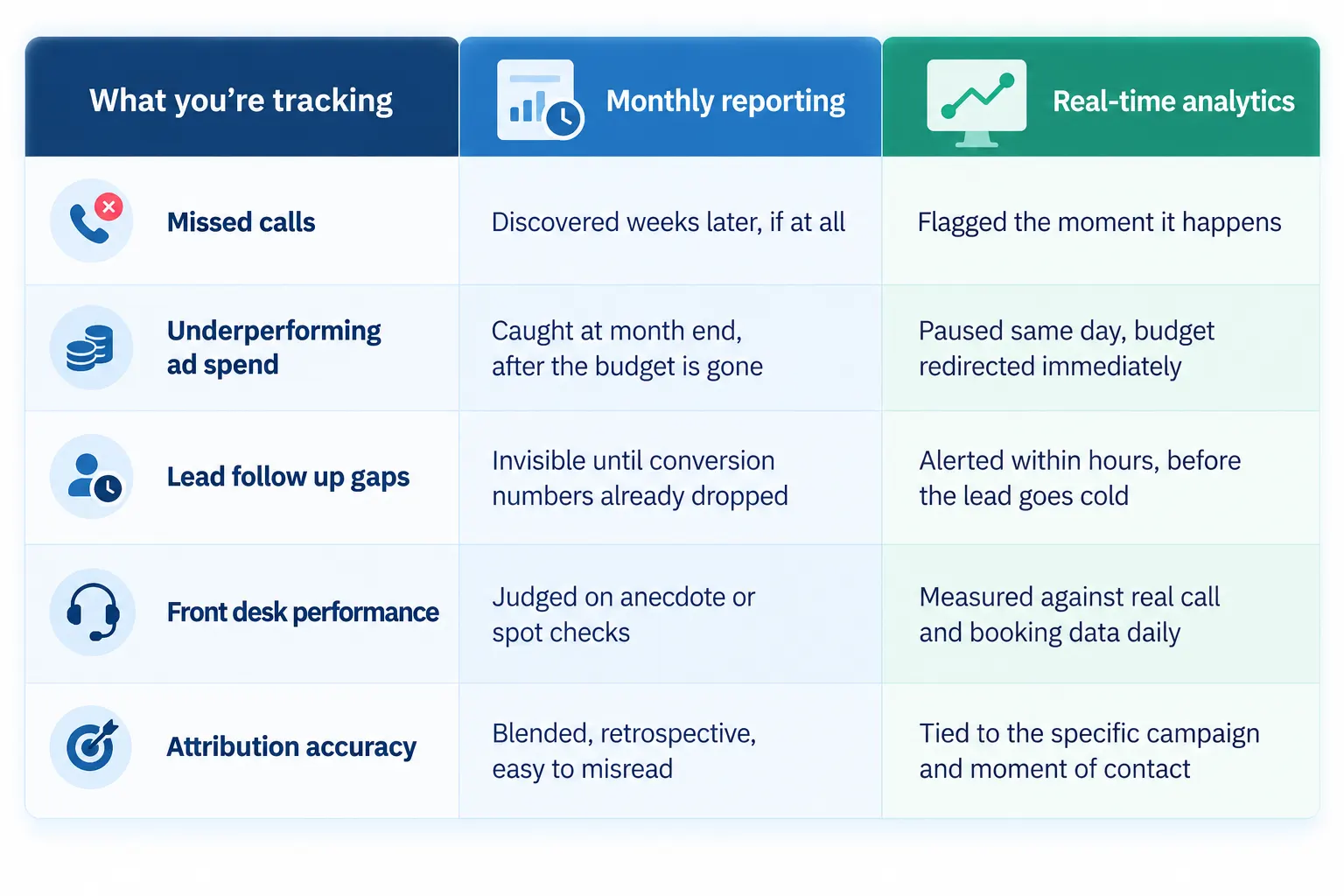
None of this means monthly reporting is worthless, it still matters for trend lines and board level conversations. The problem is treating it as your only view into the practice, since by definition it tells you about problems only after they've already cost you patients.
The stakes go up considerably once you're running more than one location. A single practice missing calls for a week is a bad week. A five location group with the same problem across even two sites is a much bigger revenue leak, and it's one that's nearly impossible to catch through monthly reports alone, since averaged numbers tend to hide exactly which location is bleeding. Real time visibility lets a DSO or multi location group compare performance site by site as it happens, catch a struggling location before the month closes, and reallocate marketing spend toward whichever office actually has the capacity and demand to convert it. Groups managing several offices tend to get more value from this than single location practices simply because the averaging effect of monthly data hides more when there's more to hide behind.
Most platforms pull from several data sources into a single dashboard rather than asking you to check each one separately: call tracking systems, website analytics, appointment booking tools, and your CRM or PMS. What surfaces in real time typically includes incoming call volume, missed versus answered calls, live appointment bookings, campaign performance by channel, and revenue attribution tied back to the source that generated it.
Think of it as a control tower for the practice rather than a monthly summary. The value isn't in any single data source, it's in seeing them together: a call tracking system alone tells you a call came in, but only when it's paired with your CRM and booking data can you see whether that call actually turned into revenue. That's the piece most practices get wrong when they bolt on one tool at a time instead of building toward a single view, and it's a mistake covered in more depth in why dashboards fail without contextual intelligence.
Some clinics take this further with predictive analytics in dental care, using historical patterns to forecast demand before it shows up, which pairs naturally with real time tracking of what's happening right now. Others focus first on simply learning how to read performance dashboards correctly, since a dashboard nobody understands is functionally the same as no dashboard at all.
Most practices that struggle here aren't short on effort, they're short on visibility. The patterns repeat: relying only on monthly reports, not tracking missed calls at all, assuming every lead converts on its own, ignoring front desk performance data, and continuing to fund ads that stopped working weeks ago.
We've watched practices lift conversions by 20 to 40% simply by fixing issues that real time data analytics surfaced, often problems that had been invisible for months under a monthly reporting cadence. One caveat worth stating plainly: the more data you're pulling in, especially anything tied to patient identity or health information, the more serious patient data protection in analytics systems needs to be treated, since HIPAA compliance doesn't get a pass just because the dashboard is convenient.
Run the math on a single missed call. If a practice books even a fraction of its calls into patients worth a few hundred dollars in first visit production, and a handful of calls go unanswered every week without anyone noticing, that's not a rounding error, it compounds into thousands of dollars a month sitting on the table. The same logic applies to ad spend: a campaign that quietly stops converting on a Tuesday but doesn't get flagged until the monthly report lands three weeks later has burned three weeks of budget for nothing. Neither of these is a hypothetical, they're the two most common findings when a practice finally turns on real time visibility after operating on monthly cycles for years. The uncomfortable part isn't that the problems existed, it's realizing how long they'd been running unnoticed.
To keep this honest, yes, a few. Getting call tracking, CRM, and dashboards actually talking to each other takes real setup time and internal alignment, it's not a plug and play afternoon project. Data overload is also a genuine risk, more numbers without clarity just gives a team more things to stare at blankly, so the fix is picking a handful of metrics that drive decisions rather than tracking everything available. And most real time platforms carry a subscription cost, though in practice the ROI from catching missed calls and reallocating wasted ad spend tends to outweigh that cost within the first few months.
1) Marketing optimization. Track which specific ads bring in real patients rather than just clicks, and adjust campaigns the same day instead of waiting for the weekly report.
2) Call tracking and conversion. Monitor call handling quality directly and close the gap on missed opportunities before they become a pattern.
3) Appointment management. Spot exactly where bookings stall in the funnel and tighten scheduling efficiency around that specific friction point.
4) Team performance. Track front desk responsiveness with real numbers instead of anecdotes, and use that data to coach rather than guess.
For a more granular breakdown of what to actually measure across these areas, marketing ROI analytics for dental practices is worth reading alongside this.
Step 1, pick your core metrics. Start narrow: calls, bookings, conversion rate, and cost per lead. Resist the urge to track everything on day one.
Step 2, choose tools that actually integrate. Look for call tracking that connects cleanly to your CRM or PMS and a dashboard simple enough that your front desk will actually open it.
Step 3, set alerts that matter. Get notified the moment a call is missed or a lead goes more than a few hours without follow up, not buried in a digest email nobody reads.
Step 4, review daily, not monthly. Ten minutes a day catching a problem while it's small beats an hour a month explaining why it grew.
Healthcare in general is getting more data driven every year, and practices still working off delayed reporting are going to feel that gap widen, not close. The ones that adopt real time analytics platforms tend to grow faster, convert a higher share of the leads they're already paying for, and make decisions based on what's actually happening rather than what happened three weeks ago.
This isn't really about the data itself, it's about control, the difference between finding out about a problem and catching it while it's still fixable. If predictable growth is the goal, real time analytics for dental practices is one of the more direct levers available right now, and pairing it with a proper dental KPI dashboard gives your whole team one place to actually see it.
What is real time analytics in dental practices?
It's the tracking and analysis of data, calls, bookings, campaign performance, as it happens rather than after the fact, so decisions can be made the same day instead of the same month.
Why does real time data analytics matter for dentists specifically?
It surfaces missed opportunities immediately, improves how many leads actually convert into booked patients, and lets you judge marketing ROI without waiting on a delayed report to tell you what already happened.
What should I look for in a real time analytics tool for a dental clinic?
Look for clean integration with call tracking, your CRM or PMS, and marketing dashboards, plus alerts that are actually actionable rather than just another notification to ignore.
How does real time analytics improve the patient experience?
By shortening response time to new leads, cutting missed calls, and smoothing out the booking process, all of which reduce the friction points that make patients choose a competitor instead.
Is real time analytics worth the cost for a smaller practice?
Usually, yes. There's a real setup cost and often a subscription fee, but the combination of recovered missed calls and reduced wasted ad spend tends to pay that back well within the first few months.
Does real time analytics work differently for multi location dental groups?
The core mechanics are the same, but the payoff is larger, since averaged monthly numbers across several locations tend to hide exactly which office is underperforming. Real time, location level data makes that visible immediately instead of at the end of a reporting cycle.



September 24, 2026
6 min
An AI receptionist checks real-time schedules, matches providers and rooms, and confirms before updating, helping dental practices reschedule appointments without double-booking.

September 23, 2026
6 min
AI receptionists can explain insurance verification, collect plan details, clarify billing terms, and answer payment questions, then pass complex account issues to your billing team.

September 21, 2026
9 min
Improve dental patient experiences with engagement technology that streamlines scheduling, strengthens retention, and eases front-desk workload.
Sign Up Now & Someone from Our Team Will Be in Touch Shortly!
Use the form below to send us a message, and we’ll get back to you as soon as we can.
.webp)
Track every marketing dollar and optimize patient conversions with ConvertLens. Gain valuable insights from your campaigns, ensuring you never miss a potential patient. Maximize ROI and grow your practice effortlessly.
-p-500.webp)